


Provided byON.energy
On July 22, 2026, a transmission line fault in Ashburn, Virginia—the heart of the world’s largest data center cluster—knocked more than 3 gigawatts of load off the grid in seconds. And it wasn’t the first time. Two years earlier, a single failed surge arrester dropped roughly 60 Virginia facilities and 1,500 megawatts at once. No one could anticipate so much uniform load responding to grid faults the same way, at the same time.
The AI power debate is mostly about generation: more turbines, more solar, more transmission. The grid needs more electrons. But the outages in Virginia weren’t supply failures; they were architecture failures. And a giant wave of interconnections is arriving on that same architecture, putting grid reliability at risk. It’s a problem nobody wants to own.
Asking more from the grid
The grid was built around predictable loads: steel mills, refineries, and houses at dinnertime. Different load sizes, same process—drawing power smoothly, misbehaving occasionally, and recovering gracefully.
But AI data centers don’t behave that way.
An AI campus can swing 70% of its load in milliseconds during a training run, then trip offline just as fast at the first sign of trouble upstream to protect billions in compute. Each is rational alone. Together, at gigawatt scale, they’re a problem the grid has never solved—and the next wave of data center campuses is planned at exactly that scale.
Where the old stack breaks
The standard data center power stack hasn’t changed in decades. Medium-voltage power arrives, transformers step it down, low-voltage uninterruptible power supply (UPS) units condition it, and it reaches the racks. Push that design to AI scale, and it cracks in three places.
First, the UPS sits deep inside the building, close to the racks. But its batteries are an undersized spare tire, designed to handle an outage for a few minutes, not to absorb load swings this fast and volatile around the clock.
Second, the UPS spends most of its life in bypass. Legacy converters waste enough power that operators run in eco-mode: A static switch feeds the racks directly from the grid and nothing filters in either direction. The compute’s swings go out raw, and grid transients—sub-millisecond events that can damage or take down equipment—come in too fast for any switch to catch.
Third, the protection logic was written when “large load” meant 50 megawatts. This protection logic can’t see the grid it is now a part of, so when trouble hits upstream, it does exactly the wrong thing: it drops out. In the 2024 Virginia event, most of the lost load traced to protection schemes that count voltage dips and disconnect on the third one—as designed, at the worst moment.
This isn’t sloppy engineering. It’s careful engineering the load has outgrown.
Moving into the path
The fix is three moves, made together.
Move it up—from 480 volts to medium voltage (13.8 kilovolts and higher), the voltage large sites draw from the grid.
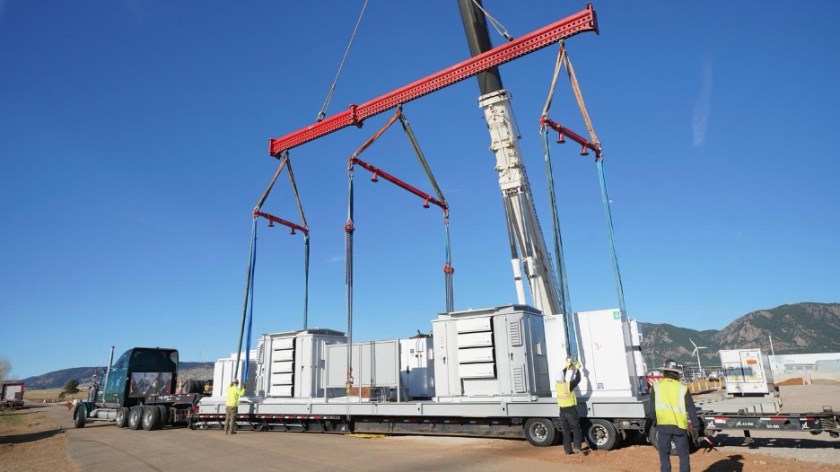
Move it out—from the data hall to modular enclosures near the substation so the building holds only compute and the cooling that keeps it alive.
Move it into the path—instead of a battery that watches and reacts, a system every electron runs through, all the time. There’s nothing to detect and nothing to switch because nothing was ever routed around it.
On paper, three straightforward upgrades. In practice, they rewrite every line item downstream.
Making the change
When thousands of GPUs spin up together, the system absorbs the swing and hands the grid a flat load profile. When a disturbance hits, the equipment behind it never notices. A difficult neighbor becomes a predictable one. And when the utility needs help, it becomes a useful one.
Interconnection changes, too. The utility certifies one medium-voltage box instead of untangling every transformer, UPS, chiller, pump, and switchgear lineup behind it. Engineers swap chip generations without a fresh interconnection study. Months come off the permitting timeline.
Inside the fence, UPS rooms become compute or cooling space. Density per construction dollar climbs.
And the economics flip. Equipment that runs at medium voltage, sits outside, and stores its own energy can qualify for tax credits, and earn revenue in grid programs like peak shaving and demand response. Backup power stops being insurance and starts paying for itself.
The architecture test
In early 2026, we tested a full-scale system at the National Laboratory of the Rockies, a U.S. Department of Energy facility and the only place in the Western Hemisphere that can replicate real grid faults and AI-scale load swings concurrently in the same loop.
We hit it from both directions: real AI load profiles hit the compute side at full medium voltage. Grid faults hit the utility side, including a full zero-voltage event. The compute side didn’t flinch. Neither did the grid side. It cleared the large-load voltage ride-through requirements from the Electric Reliability Council of Texas (ERCOT), the grid operator, with room to spare.
Those rules exist because operators no longer take facilities this size on faith, and more are coming. Most of the industry treats them as hurdles. A medium-voltage, inline system clears them out of the box. Compliance isn’t an added feature. It’s what the architecture does.
The new layer
Much of what looks like a grid problem in the AI buildout sits inside the fence, in equipment sized for a load that no longer exists. Move the right pieces up, out, and into the path, and a grid liability becomes a grid asset. Density goes up. Permitting time comes down. Backup power earns its keep.
The engineering works—and the next wave of AI factories is being built on it. The industry hasn’t named this layer yet. We call it the medium-voltage AI UPS. The name matters less than the choice: those factories can arrive as a strain on the grid or as strength for it. We already know how to build the second kind.
This content was produced by ON.energy. It was not written by MIT Technology Review’s editorial staff.