


Bitcoin

Bitcoin

$77,213.55

BTC 0.28%

Ethereum

Ethereum

$2,106.63

ETH 0.42%

  • Login
  • Register
Metaverse Media Group
  • Home
  • Crypto
  • NFTs
  • Artificial Intelligence
  • More
    • Technology
    • Business
    • Newsletter
No Result
View All Result
  • Home
  • Crypto
  • NFTs
  • Artificial Intelligence
  • More
    • Technology
    • Business
    • Newsletter
No Result
View All Result
Metaverse Media Group

Qwen-Drive 1.0 tells you why it brakes, just don’t expect the explanation to match the maneuver

Qwen-Drive 1.0 tells you why it brakes, just don’t expect the explanation to match the maneuver

The Decoderby The Decoder
7 September 2026
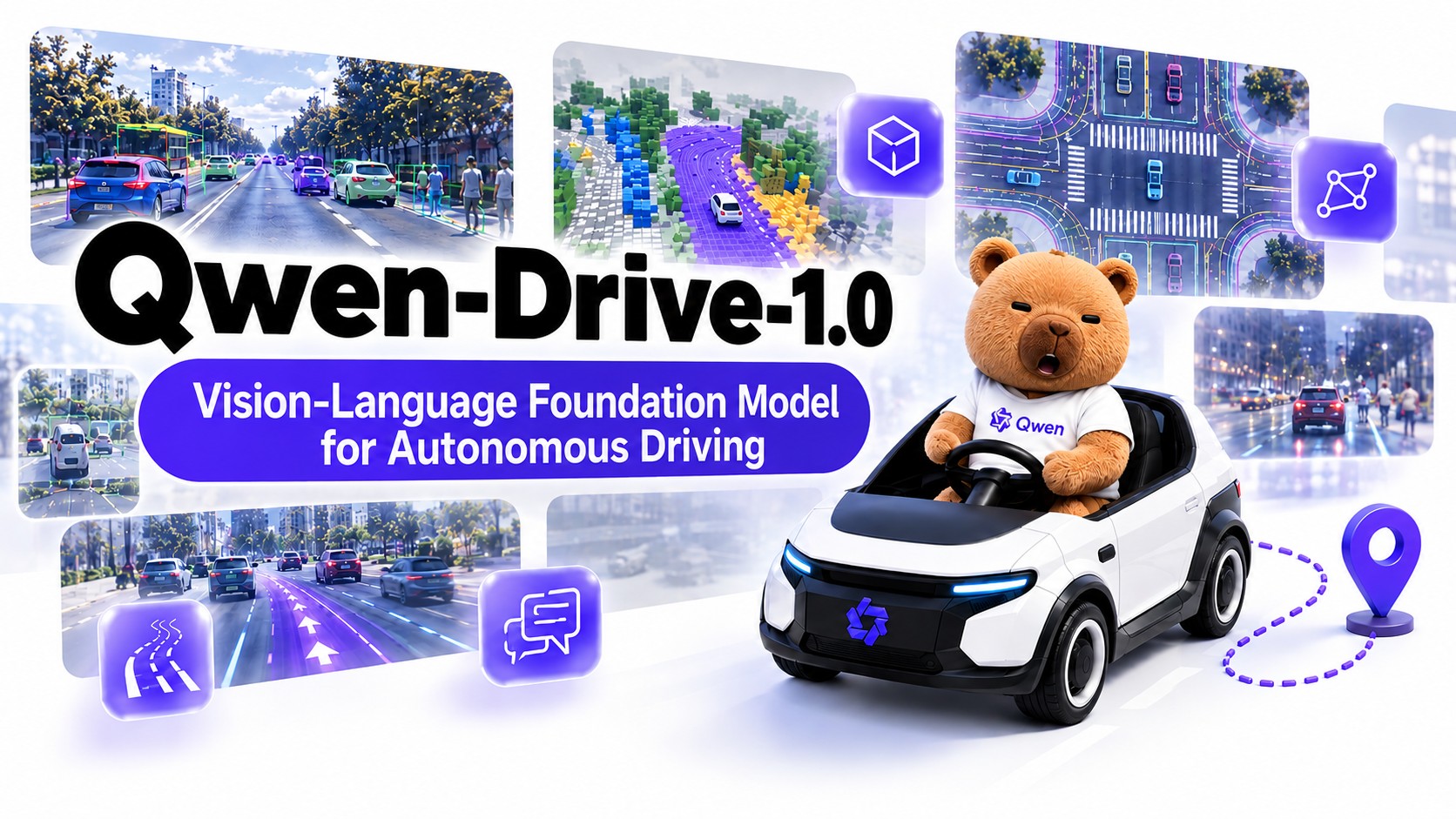
Alibaba’s research arm has released Qwen-Drive 1.0, an AI model that handles environmental perception, traffic Q&A, and route planning in one system. The researchers show that text-image models don’t automatically understand three-dimensional space. Spatial awareness has to be trained on purpose. The goal is a single model that runs both the cockpit and the driving system. The article Qwen-Drive 1.0 tells you why it brakes, just don’t expect the explanation to match the maneuver appeared first on The Decoder….


Jonathan Kemper


Sep 7, 2026

Image description

Key Points

  • Alibaba’s Qwen-Drive 1.0 handles spatial perception, traffic questions, and route planning in one AI model.
  • Two modules for 3D mapping and route planning extend the base language model, letting the AI run as both a driving system and a cockpit assistant without losing existing knowledge.
  • Retraining cut the rate at which the car veered off the road from 24 percent to 12 percent in simulations. But the model’s explanations don’t always match the driving decisions it makes.

Qwen-Drive 1.0 handles three tasks in one AI model: spatial perception of the environment, answering questions about traffic, and route planning. The researchers confirm that a text-image model doesn’t automatically understand three-dimensional space just because it can describe pictures.

Existing driving models take a general text-image model and fine-tune it on driving data, mostly question-and-answer pairs about traffic situations. According to the paper, this approach has two weaknesses. A model trained mainly on traffic Q&A still can’t reliably detect distances, positions, and open spaces. And if it becomes too specialized on driving data, it loses the broad general knowledge from its original training through what the researchers call “catastrophic forgetting,” which is exactly the kind of knowledge that matters most in rare, unexpected traffic situations. The model Alibaba’s research division built is supposed to address both problems.

A separate module checks whether the model actually understands space

Qwen-Drive-1.0 builds on Qwen3.5-4B, released in February, and adds two extra components. The first generates a bird’s-eye-view map of the surroundings by spotting objects in 3D space, figuring out which areas are occupied, and tracing the road layout. The researchers say it doubles as a measuring tool that reveals how much spatial information the model is actually pulling from the images.

Architecture diagram of Qwen-Drive-1.0 showing the Vision Encoder, Qwen3.5 Language Model, external BEV Perception Head for 3D detection, occupancy, and map segmentation, plus a Planning Expert for trajectory output.
All driving functions run through a shared language model. Two added modules tap into its intermediate results: one builds a 3D model of the environment, while the other plans the car’s route for the next few seconds. | Image: Qwen

The second component, the Planning Expert, uses internal model data to plan the car’s future movement. When the researchers trained only the added component and left the vision-language model untouched, spatial accuracy stayed low, confirming that a model capable of describing images in detail doesn’t automatically grasp three-dimensional space. Only when the team also trained the vision-language model itself on spatial tasks did performance improve significantly, meaning the ability to spatially understand traffic scenes has to be built in deliberately.

Four scene rows with multi-view camera images, 3D object detection in bird's-eye view, semantic occupancy maps, and BEV map segmentation, each comparing the model's prediction against ground truth.
The model reconstructs a top-down view of each scene from camera images, showing vehicles, pedestrians, and road markings. On the right, the prediction appears next to the actual situation. | Image: Qwen

Training starts with the perception module, then combines perception and question answering, followed by route planning. The final step refines the model’s behavior through reinforcement learning. For the vision-language component, the team combined 24 publicly available datasets of traffic scenes. These datasets had different structures and sometimes contained errors. An AI model standardized the questions and answers and aligned them with the original data. The team also built its own examples explaining why the car should make a specific driving decision, like which object triggers braking.

One model for both the cockpit and the driving system

In modern vehicles, the infotainment system and the driving system are converging on a single computing unit instead of running on two separate controllers. The authors argue that a model trading general capabilities for pure driving performance doesn’t help here, because the cockpit would still need its own model and extra compute for tasks like dialog or open-ended questions.

Two radar charts comparing Qwen-Drive-1.0 against models like Qwen3.5-4B, MiMo-Embodied-7B, and InternVL3.5-8B across Driving VQA, General VQA, 3D Perception, and Motion Planning benchmarks.
In Qwen’s own benchmarks, Qwen-Drive 1.0 beats specialized models in most driving and perception categories. | Image: Qwen

Qwen-Drive 1.0 scores well above the unmodified base model Qwen3.5-4B on questions about traffic scenes, according to the paper. The biggest gap shows up when the model has to explain cause and effect, like why the car should brake or turn. General knowledge holds up too: The model shows almost no drop on tests outside of driving and even scores slightly higher on some spatial tasks.

From simulation to the road

For driving planning, the team tested the model at several difficulty levels, from simple predictions up to a simulator where errors compound over time. In the simulator, the version retrained with rewards cut the rate at which the car veered off the road from 24 to 12 percent. It also drove more cautiously and covered less distance overall.

Three open-loop driving scenes with overlaid reasoning text and predicted trajectories at top, and eight closed-loop time steps from two AlpaSim runs with camera images and trajectory plots below.
In each scenario, the model explains its driving decision, like braking for an animal on the road or stopping at a red light. The blue line shows the planned route. | Image: Qwen

The model’s explanations don’t always pinpoint the actual cause of a situation, though. A red light in the distance and a child stepping into the road call for very different reaction times, and the model can conflate the two. The planned maneuver also doesn’t always match the reasoning the model gave beforehand. Some results rest on test procedures the authors designed or rebuilt themselves, so individual metrics say little about how the system would handle messy real-world driving.

Four scene rows with camera images from unfamiliar camera configurations in WOD-E2E and PAI-AV, showing 3D detection, occupancy, and map segmentation results without ground truth comparison.
The model detects far less when processing footage from other vehicles with different camera setups. Suitable training data for those configurations is still missing. | Image: Qwen

The Qwen team measured this gap in spatial understanding itself using its HopChain benchmark. Here, vision-language models misclassified objects and confused spatial relationships even while scoring well on image-text benchmarks. Catastrophic forgetting is a familiar problem, too. When Google Deepmind built PaLM-E in 2023, a model for language, images, and robot control, the smaller variants lost a big chunk of their language ability after robot training. The largest version, at 562 billion parameters, lost almost nothing.

Pairing a language model with a driving function opens up a new attack surface. Researchers at UC Santa Cruz placed a labeled sign in the camera’s field of view and tricked the DriveLM driving system into swerving toward crossing pedestrians, even though it had detected them correctly. Research is meanwhile shifting toward World Action Models, which also predict how the environment changes in response to the agent’s own actions.

The Qwen team is releasing the model to the research community for free on Hugging Face, ModelScope, and GitHub.

AI News Without the Hype – Curated by Humans

Subscribe to THE DECODER for ad-free reading, a weekly AI newsletter, our exclusive “AI Radar” frontier report six times a year, full archive access, and access to our comment section.


Subscribe now

Read the full article on The-Decoder.com
in AI
Reading Time: 6 mins read
0
0
23
VIEWS
Share on TwitterShare on Facebook

Subscribe to our newsletter

For the latest news & monthly prize giveaways
Join Now

Subscribe to our newsletter

For the latest news & monthly prize giveaways
Join Now
ADVERTISEMENT

Related Posts

Whispering Complaints Into Your Phone May Be the Future of Customer Feedback
AI

Whispering Complaints Into Your Phone May Be the Future of Customer Feedback

3 hours ago
22
Pixel 11 review: Google sets the bar for standard flagship phones
AI

Pixel 11 review: Google sets the bar for standard flagship phones

7 hours ago
21
Designers should not fear being replaced by AI, industry leaders say
AI

Designers should not fear being replaced by AI, industry leaders say

9 hours ago
20

Comments

Please login to join discussion
ADVERTISEMENT

Latest News

  • All
  • Crypto
  • NFTs
  • Technology
  • Business
Irish Gangs Are Renting Private Vaults to Hide Crypto Keys
Crypto

Irish Gangs Are Renting Private Vaults to Hide Crypto Keys

Decrypt
by Decrypt
27 minutes ago
21
OpenAI chief scientist warns no one is prepared for consequences of AI
Technology

OpenAI chief scientist warns no one is prepared for consequences of AI

BBC News
by BBC News
49 minutes ago
22
Qwen-Drive 1.0 tells you why it brakes, just don’t expect the explanation to match the maneuver
AI

Qwen-Drive 1.0 tells you why it brakes, just don’t expect the explanation to match the maneuver

The Decoder
by The Decoder
55 minutes ago
23
Dolly Parton’s sister pleads for end to ‘AI garbage’ posts after singer’s death
Technology

Dolly Parton’s sister pleads for end to ‘AI garbage’ posts after singer’s death

BBC News
by BBC News
2 hours ago
21
Zcash, XRP and Solana Bets Push Altcoin Leverage Past Bitcoin
Crypto

Zcash, XRP and Solana Bets Push Altcoin Leverage Past Bitcoin

Bitcoin.com News
by Bitcoin.com News
2 hours ago
23
Coldcard Hacker Moves $7.7M, Nearly Half of Third-Wave Bitcoin Haul
Crypto

Coldcard Hacker Moves $7.7M, Nearly Half of Third-Wave Bitcoin Haul

Decrypt
by Decrypt
2 hours ago
23
Load More
Next Post
OpenAI chief scientist warns no one is prepared for consequences of AI

OpenAI chief scientist warns no one is prepared for consequences of AI

ADVERTISEMENT

Follow Us

Categories

  • Crypto
  • NFTs
  • AI
  • Technology
  • Business
  • Crypto
  • NFTs
  • AI
  • Technology
  • Business
Subscribe to our Newsletter

© 2022 Metaverse Media Group – The Metaverse Mecca

Privacy and Cookie Policy | Sitemap

Welcome Back!

Sign In with Google
OR

Login to your account below

Forgotten Password? Sign Up

Create New Account!

Sign Up with Google
OR

Fill the forms below to register

*By registering into our website, you agree to the Terms & Conditions and Privacy Policy.
All fields are required. Log In

Retrieve your password

Please enter your username or email address to reset your password.

Log In
No Result
View All Result
  • Home
  • Crypto
  • NFTs
  • Artificial Intelligence
  • More
    • Technology
    • Business
    • Newsletter
Bitcoin

Bitcoin

$77,213.55

BTC 0.28%

Ethereum

Ethereum

$2,106.63

ETH 0.42%

  • Login
  • Sign Up
This website uses cookies. By continuing to use this website you are giving consent to cookies being used. Visit our Privacy and Cookie Policy.

Subscribe to our newsletter

Get the latest news & win monthly prizes

Subscribe to our newsletter

For the Latest News and Monthly Prize Giveaways

Join Now
Join Now