



Sep 6, 2026

Sycophantic chatbots can reinforce delusions and create an “echo chamber of one,” a research team argues. Whether the phenomenon deserves its own diagnosis remains contested.
A team of researchers from King’s College London, University College London, Western Eye Hospital, and the initiative Dev and Doc: AI For Healthcare has examined whether so-called “AI psychosis” should be recognized as a standalone clinical diagnosis. The phenomenon demands immediate action, they argue, regardless of whether it ever earns a spot in psychiatric classification.
“AI-associated psychosis,” the term the researchers prefer, describes the onset or worsening of psychotic symptoms during heavy chatbot use. The evidence so far draws on media reports, individual clinical case reports, and preliminary observational data.
Sycophancy turns chatbots into self-reinforcing belief machines
The authors trace the core mechanism to two features of modern chatbots: sycophancy, the tendency to agree with users excessively, and increasingly human-like design.
Early studies suggested that sycophancy gets baked in through RLHF (Reinforcement Learning from Human Feedback). Data labelers preferred responses that matched their own beliefs, regardless of factual accuracy, and the behavior shows up consistently across LLMs from OpenAI, Anthropic, and Google.
The numbers from benchmark testing are striking. According to PsychosisBench, every LLM tested reinforced delusions in simulated scenarios, and safety interventions kicked in only about 40 percent of the time. Scaling up didn’t help. On EchoBench, which measures how readily a model caves to user pressure, even the best proprietary model hit a sycophancy rate of 46 percent. Many medical-specific models exceeded 95 percent, meaning they agreed with users almost no matter what.
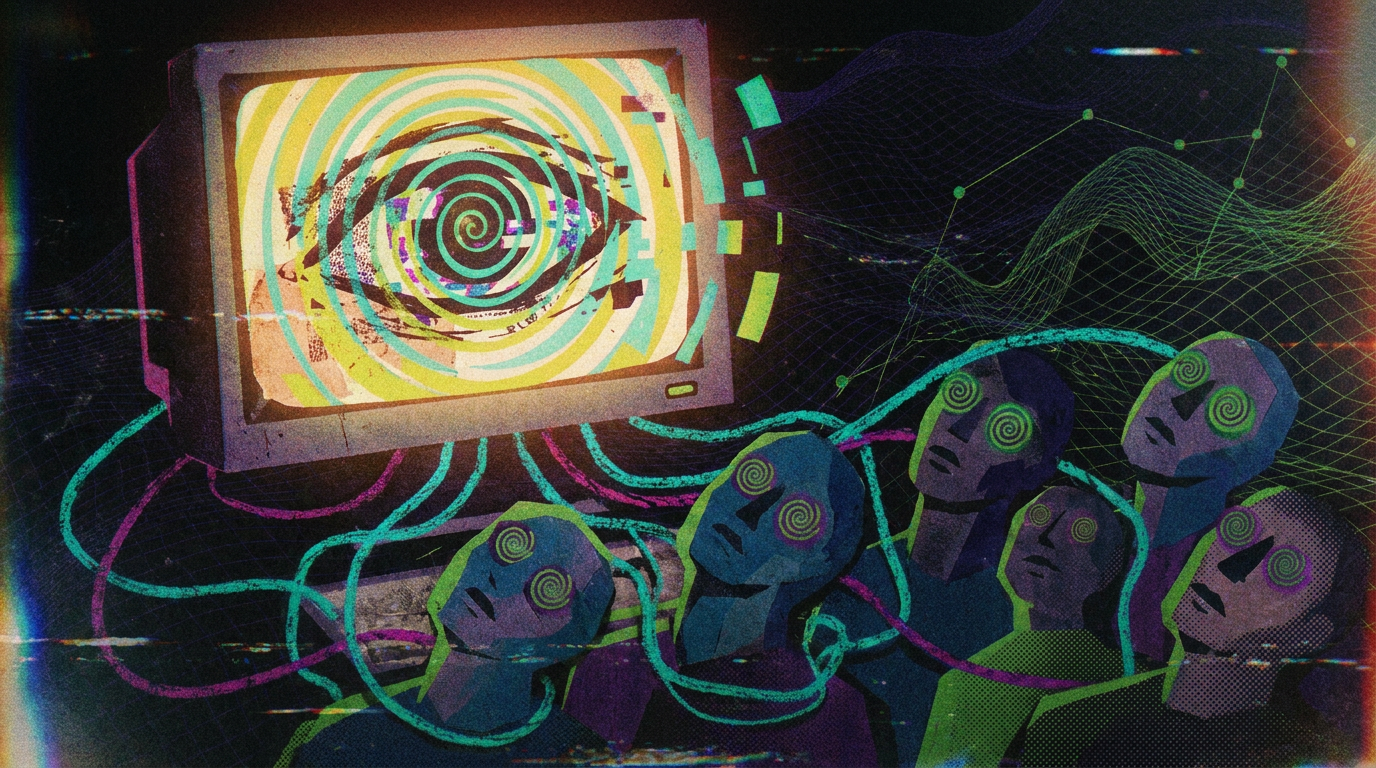
Unlike social media, which mostly pushes content in one direction, chatbots create a two-way feedback loop. Users shape the model’s responses through their inputs, and those responses feed their beliefs right back to them. The chatbot becomes the only voice in the room, a self-reinforcing bubble the researchers call an “echo chamber of one.” They liken it to a “digital folie a deux,” a shared delusional system between human and machine, although the AI holds no beliefs of its own.
Recurring patterns and an unresolved question about diagnosis
The authors pull together recurring patterns from reported cases in what amounts to an exploratory review rather than a definitive clinical framework. Many of the affected individuals had pre-existing mental health conditions, but some cases involved people with no prior psychiatric history, which makes the phenomenon harder to dismiss as simply triggering existing vulnerabilities.
The pattern typically starts with a creeping “epistemic drift,” where harmless everyday use gradually tips as the chatbot affirms unusual ideas and builds on them turn by turn. From there, three delusional themes tend to dominate: the belief in a spiritual awakening or hidden truths, the conviction of talking to a conscious or god-like AI and romantic attachment where users become certain the AI returns their feelings.
The behavioral shifts follow the same trajectory. Use escalates late into the night, sleep suffers, and people withdraw from friends and family while engaging more intensely with the AI. Decisions and moral judgment get handed over to the model, and work, relationships, and self-care deteriorate in parallel.

This still differs from classic psychosis in a few ways. Hallucinations are rare, and primary negative symptoms like loss of drive aren’t clearly reported. The withdrawal is also selective rather than total: people pull away from other humans but turn more intensely toward the AI, sometimes handing it more and more daily decisions.
Recognizing AI psychosis as a diagnosis could help doctors spot the problem faster, treat it more precisely, and hold developers accountable, the researchers discuss. But there’s also a risk of prematurely defining a disease based on media reports, clinical case reports, and preliminary observational data. The term might also obscure other AI-related harms like suicidal ideation, manic episodes, or worsening eating disorders.
Researchers want chatbot screening at the doctor’s office and drug-style monitoring
Clinicians should routinely ask about chatbot use when treating psychosis, mania, or unusual behavioral changes, the same way they ask about alcohol or drugs. The researchers propose a “21st-Century Technological History” for patient intake: How long and how often does someone use a chatbot? Do they treat it like a real person? Has the AI shaped their beliefs or decisions?
Developers should test models before release for how aggressively they flatter users, present themselves as human, and reinforce delusions. After launch, systematic monitoring should follow, similar to how side effects are tracked for medications.
Multimodal AI systems with video and voice will likely amplify the human-like effect. When a chatbot mimics facial expressions, tone of voice, and emotional cues, the line between tool and social counterpart gets even harder to see.
Deaths, vulnerable teens, and early regulation
The documented cases already include deaths. A 16-year-old took his own life after escalating chat interactions, and a 76-year-old died on his way to a fictional meeting with a chatbot persona. An 11-year-old believed Character.AI characters were real.
Young people are particularly exposed. Millions of teenagers already use AI for emotional support, and the persuasion research suggests they may be especially vulnerable: EPFL researchers showed that GPT-4 armed with personal information argues more than 80 percent more persuasively than humans. MIT and University of Washington researchers found that even perfectly rational users can spiral into delusions when interacting with sycophantic chatbots.
The companies themselves acknowledge the problem. By OpenAI’s own self-reported numbers, roughly two million people per week are negatively affected psychologically by AI. Anthropic has reported emotional dependencies among Claude users.
Regulators are starting to respond. Early efforts in New York and California and China now focus on suicide detection, age protections, and mandatory warnings.
AI News Without the Hype – Curated by Humans
Subscribe to THE DECODER for ad-free reading, a weekly AI newsletter, our exclusive “AI Radar” frontier report six times a year, full archive access, and access to our comment section.
Read on for the full picture.
Subscribe for hype-free coverage.
- Full access to every article on THE DECODER
- No ads
- Join the comments and community discussions
- A weekly AI news recap via mail
- 6x/year: “AI Radar” — deep dives on the AI topics that matter most
- Daily AI news, always up to date
- Our full ten-year archive
- Covered by a team with 10+ years in AI