
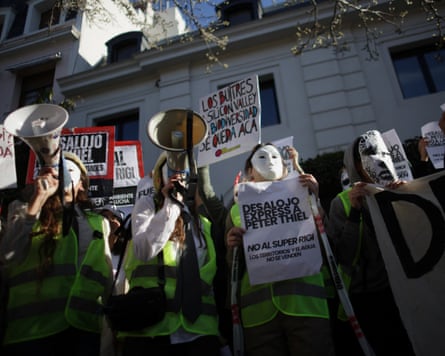

Dozens of protesters converged on Peter Thiel’s mansion in Buenos Aires this week after a congressional session raised questions about the billionaire’s presence in the country.
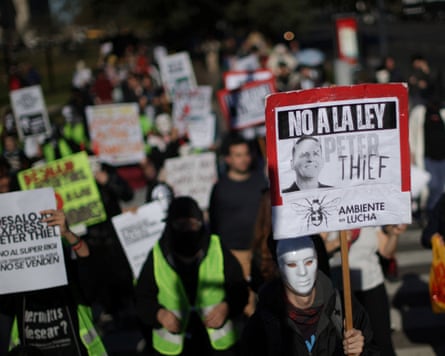
In white masks, they held signs saying “Peter Thief” and “No to the Peter Thiel law” in front of the wrought-iron gates of the $12m (£8.9m) residence, which Thiel bought in April as he moved his family to Argentina.
There is broad unease at the tech magnate’s presence in the country. His move has been characterised as part of a plan to hedge against world war three: Argentina, agriculturally rich and deep in the southern hemisphere, might just be the ideal place for a tech billionaire to wait out the apocalypse.
But recent developments in the country suggest Thiel could have more pragmatic considerations.
Last week, Argentina’s chamber of deputies held a six-hour debate on a set of sweeping regulatory changes put forward by Javier Milei’s rightwing government shortly after Thiel moved to Buenos Aires. They invited Thiel, Milei and an official linked to Argentina’s intelligence services to answer questions.
“None of them answered, and none of them came to the meeting,” said Juan Marino, a member of the chamber of deputies and the leader of the Piquetero party.
Marino said the new laws amounted to a “technofascist legislative package” aimed at entrenching the power of US tech billionaires in the country. Thiel has not publicly advocated for them, but Marino and others have said that their timing was suggestive.
The meeting in the chamber of deputies came after Argentinian deputies from several parties made public requests to the government for information about Thiel, his meetings and his businesses. None have been answered.
One of the laws, the “super RIGI”, would put in place an investment regime offering foreign companies a minimal tax rate and a 30-year guarantee against regulatory change. It specifically names AI datacentres among investments it hopes to attract.
Another, which failed, aimed to eliminate most of the restrictions around foreigners buying land in Argentina. A final decree would require some civilian government departments to share vast amounts of personal data on Argentinian citizens with the state intelligence services.
There is no evidence that Thiel has advocated for these laws directly. But in the months after he moved to Buenos Aires, he held closed-door meetings with Milei and key presidential advisers. It is uncommon for a foreign investor to have this degree of access.
In the regulatory package, Marino and others see the footprint of Thiel’s larger techno-libertarian interests.
The decree that gives vast amounts of Argentinians’ personal data to state intelligence services comes as Argentinian deputies have asked increasingly pointed questions about whether Palantir, the company Thiel co-founded, has undisclosed contracts with the state, which have gone unanswered.
The land law, said Marino, could have paved the way for semi-autonomous “startup cities” – such as the controversial Próspera development in Honduras – that Thiel has advocated as a way for libertarians to carve out zones outside state control.
“Argentina is kind of a laboratory,” said Cecilia Nicolini, who represents Argentina at the Mercosur regional parliament. US tech billionaires, she said, “are using Argentina as a laboratory, because they have a person in power, Milei, who is even more crazy than they are”.
Over the summer Milei wrote an article in the Financial Times advocating the creation of “non-human corporations” – “entities operated by AI agents or robots”.
It parallels a vision put forward by OpenAI’s chief executive, Sam Altman, who predicted in 2024 that the world could soon be run by AI-owned companies. It also raises dark, thorny questions about the legal liabilities of those entities.
Nicolini said: “It’s not just that [Thiel] chose Argentina in terms of, it’s a secure place to live in a world that is facing a number of wars, etcetera.
“But really, behind it, I think there is a clear plan. And it is related to reforms that Milei is trying to pass, with some success in some cases, and in others, backlash.”
Thiel was approached for comment.